
- Introduction
- Background
- How this was achieved
- AFL fields shapes (2020-2025)
- The AFL isn’t unique…
- … but uniqueness in sport matters
Introduction
Conversations about different field shapes and sizes happen all the time. It’s usually comments about Kardinia Park having a flat wing giving it a distinctly asymmetrical shape, or whenever a game is played on Norwood Oval you cannot escape comments about the unique “rectangleness” of the field.
Comments about field shapes, their impact on the game, and how teams adjust to deal with these changes are a constant. The ABC touched on this topic in a previous article (C. Atkinson & S. Lawson. “From the SCG to Kardinia Park — do ground sizes contribute to the end result in AFL games?“), which I highly suggest you check out. Their finding are summarised in their final paragraph:
“The lack of impact of ground sizes speaks to the intent of the founders of the game — that the players make the game, and not where they play it. A good team will be a good team no matter the size or shape of the ground, which is how footy should be.”
However, I don’t think they told the full story.
I want to use this article to unpack one of the main reasons for that – not only are oval lengths and widths different, but so are their shapes. They are asymmetrical, lop-sided, rectangle in some cases (a second Norwood mention), to the degree where you haven’t realised when looking at a ground from the tilted TV angle we are offered. I do think these features play a factor in how the game is played, and how a home team may use those factors to their advantage.
Let’s find out more.
Background
The AFL has an extremely relaxed definition for a legal playing surface. In the AFL rule book (AFL. “Laws of Australian Football 2024“), these are the requirements:
3.2 PLAYING SURFACE
- The Playing Surface shall be:
- oval in shape;
- between 135 metres and 185 metres in length; and
- between 110 metres and 155 metres in width.
Not only are these not very strict requirements, but they leave so many possible playing surfaces untouched. To give an example of this, these are all the fields played on since between 2020-2025 graphed by length (distance from goal to goal) and width with the shaded area showing all legally available dimensions.

There are two new pieces of information that can be drawn from this:
- Out of the legal range of fields possible, only a small subset of widths were utilised – meaning, that large variation is legally possible and I suspect that the extremes accessible could be game altering. If a home field advantage were ever to be exploited, this is an unexplored dynamic; and
- Field length is the main contributor to field area (total size), and would be the main factor in any game-style differences employed from field to field.
To highlight how extreme a legal AFL field shape can look, let’s look at the wildest examples. Here are the extreme aspect ratios legally possible (see Figure 2), compared to the MCG.

How this was achieved
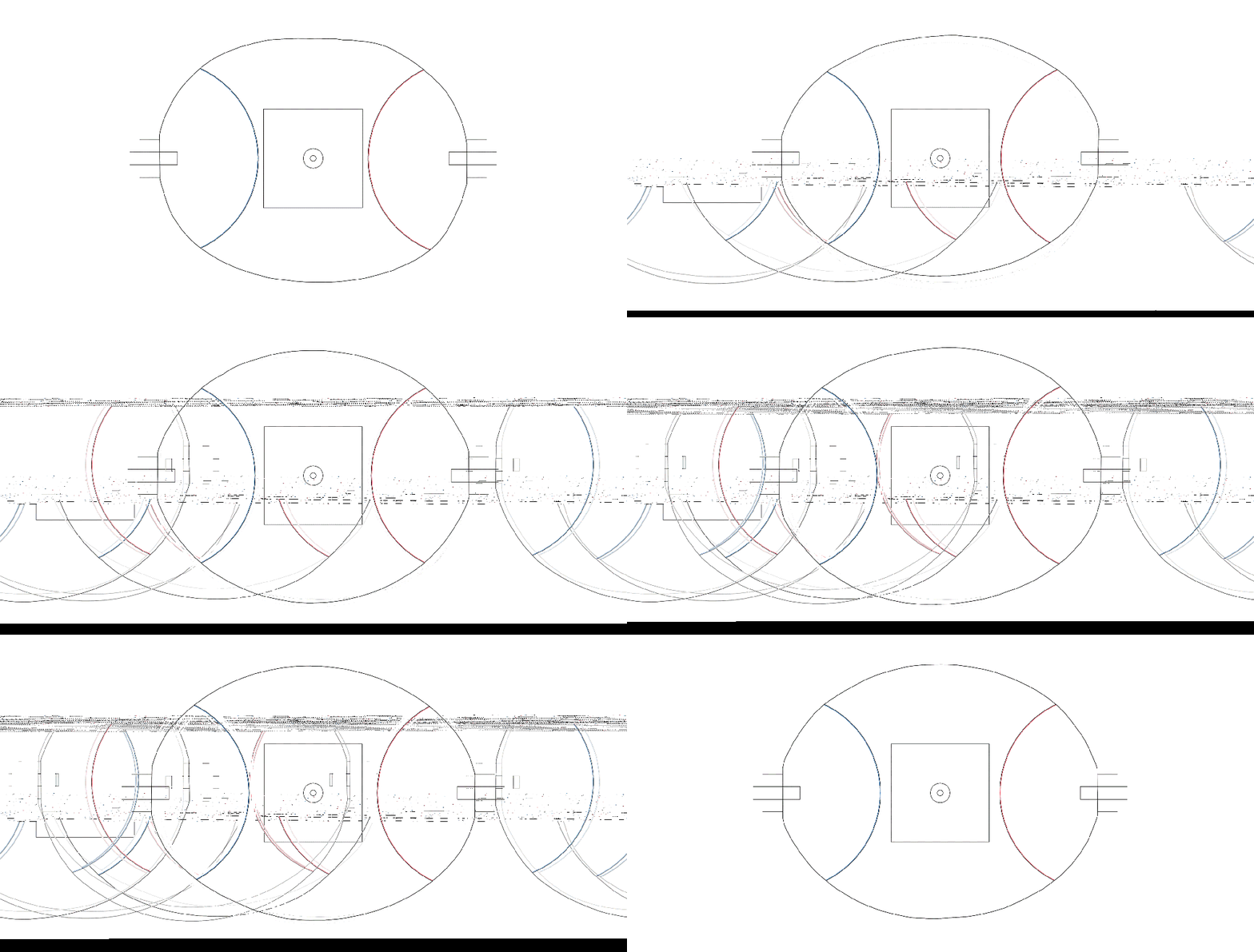
This is the nerdy part so I will try to keep it short – even made a GIF for you so you don’t have to read the detailed version.
These images will help build better graphics in the future as I produce more articles. Very excited to see what that all looks like as I progress with this website.

Click to see a description of steps taken:
| Step | Description |
|---|---|
| 1 | Using Google Earth, a historical image was able to be found showing how a field, with drawn boundaries, looks during game day. |
| 2 | Each fields perimeter was then traced, noting the TV viewing angle so that all fields are represented as would be observed from a viewers perspective (red 50 m line is to the right of the main camera and the blue 50 m line to the left). |
| 3 | Download the .kml file of all the traces, and read them using Python for transformation. |
| 4 | Transform the field: – rotate the trace showing the viewing angle consistently (left to right); – centre the field; – use the drawn trapezium boundary to stretch the shape of the field so that goal lines are parallel, ironing out other irregularities due to satellite imagery; and – resizing the field to their official length and width measurements |
| 5 | Finally, draw field elements such as goal squares, centre square and circle, add goal posts, etc. |
AFL fields shapes (2020-2025)
This is the highlight of the article. I have never seen this examination of field shapes and it’s an interesting aspect of our game to take note of.
There are plenty of candidates to critique – please do – and see them all in Figure 3 where the fields are shown as they would be viewed on TV (left to right):
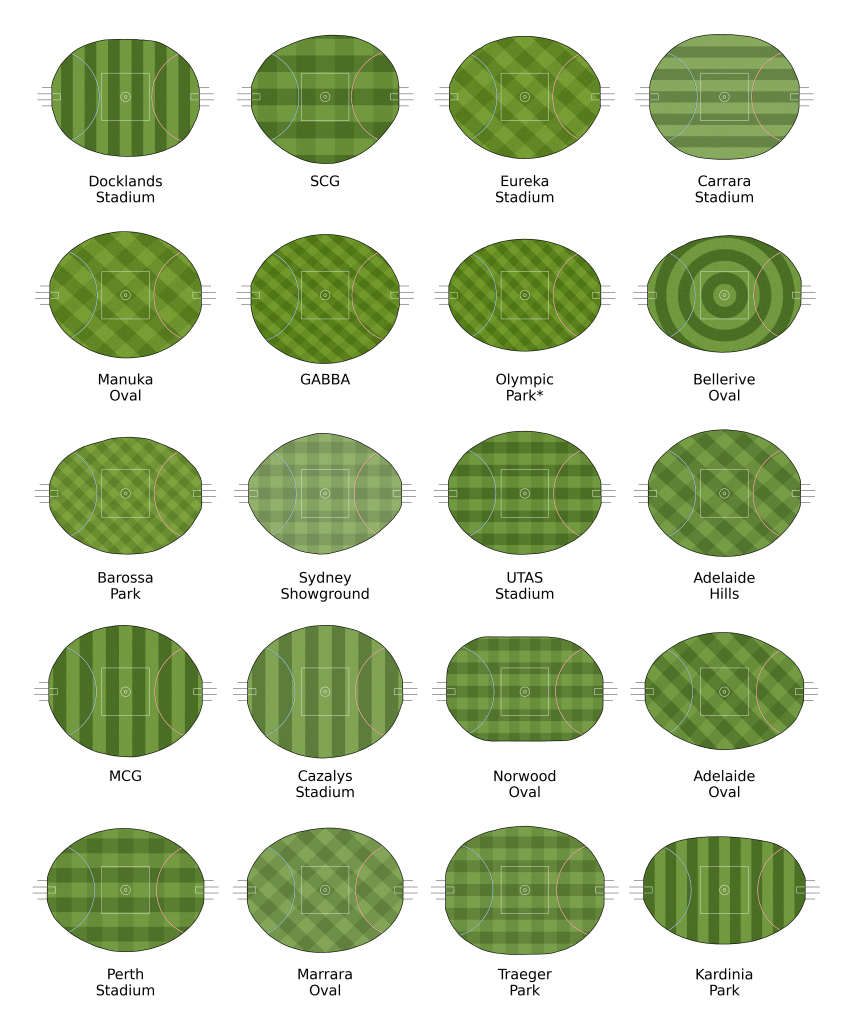
* indicates that the officially stated height and width used to draw oval.
The AFL isn’t unique…
Non-uniformity is common in sport, and something that should be celebrated due to how it affects the outcome, adding a home team advantage element to the game, and how the game is more than just the people playing it. This is common is other sports as well.
Below are some examples of how from other sports:
| Sport | Description | Link |
|---|---|---|
| Cricket | The BBC has a great article looking at the shapes of all English cricket fields used in the ICC Cricket World Cup 2019. | S. Nazmi. “The many shapes of England’s cricket stadiums“ |
| Baseball | Funnily enough, the opening quote in this YouTube video is “Baseball is the only major sport where the playing field itself can change shape from stadium to stadium”. | Voice to Victory. “Why Baseball Refused to Standardize Its Fields“ |
| Soccer | Surprising, even soccer fields aren’t standardised. | thehalftimepint. “Are Premier League football pitches different sizes?“ |
… but uniqueness in sport matters
I mentioned before that the ABC article may have missed a key factor in their analysis – not all AFL fields are symmetrical and follow the mathematical rules of perfect ovals (using only the length and width to determine the area). And I want to highlight how real fields deviate from this.
Figure 4 compares what the area to a comparable perfect oval to the actual area of the fields.

Click for a table full of the data.
| Name | Length (m) | Width (m) | Area (m2) Actual | Perfect | Difference (%) |
|---|---|---|---|---|
| Docklands Stadium | 155.4 | 123.3 | 15,786 | 15,049 | 4.90 |
| SCG | 155.3 | 135.2 | 16,491 | 16,498 | 0.04 |
| Eureka Stadium | 158.9 | 128.8 | 16,084 | 16,074 | 0.06 |
| Carrara Stadium | 157.4 | 131.5 | 17,003 | 16,256 | 4.59 |
| Manuka Oval | 159.7 | 133.0 | 16,759 | 16,682 | 0.46 |
| GABBA | 156.3 | 135.8 | 16,794 | 16,671 | 0.74 |
| Olympic Park | 160.0 | 118.0 | 14,979 | 14,828 | 1.01 |
| Bellerive Oval | 161.8 | 123.0 | 15,840 | 15,631 | 1.34 |
| Barossa Park | 160.5 | 123.1 | 15,675 | 15,518 | 1.02 |
| Sydney Showground | 161.1 | 127.2 | 15,508 | 16,094 | -3.64 |
| UTAS Stadium | 160.8 | 129.7 | 16,544 | 16,380 | 1.00 |
| Adelaide Hills | 160.4 | 133.3 | 16,946 | 16,793 | 0.91 |
| MCG | 161.6 | 138.5 | 17,656 | 17,578 | 0.44 |
| Cazalys Stadium | 163.7 | 139.8 | 18,108 | 17,974 | 0.75 |
| Norwood Oval | 164.8 | 109.9 | 15,954 | 14,225 | 12.16 |
| Adelaide Oval | 167.2 | 123.4 | 16,199 | 16,205 | -0.04 |
| Perth Stadium | 165.1 | 129.7 | 16,919 | 16,818 | 0.60 |
| Marrara Oval | 164.1 | 131.0 | 17,186 | 16,884 | 1.79 |
| Traeger Park | 167.1 | 135.1 | 18,778 | 17,731 | 5.91 |
| Kardinia Park | 170.1 | 113.1 | 15,860 | 15,110 | 4.96 |
Figure 4 acts as a check: is using the area of a perfect oval enough to describe the differences between these fields. For the most part, as you can see, the answer is yes. Most fields are close the the parity line between perfect and actual areas (x=y).
This indicates that 19 out of the 20 fields shown either meet parity, or are larger than than a comparable perfect oval, stretching out pockets of the field to a more rectangle shape.
The outliers are Norwood (12.16 % larger), Kardinia (4.96 % larger), Docklands (4.90 % larger), Sydney Showgrounds (3.64 % smaller), and Traeger (5.91 % larger) than parity. And the ranges of area is between 15,000-18,800 m², a massive 25 increases between the smallest and largest field, all from a predominantly longer length of field.
I believe that looking at field shapes like this can help appreciate the odd characteristics of out sport. Although it’s not unique to AFL, it’s something that should be celebrated, and understanding how variable playing fields are can expand the conversation from Kardinia Park and Norwood Oval, to the SCG’s odd asymetry, or the Sydney Showgrounds egg shape.
Can field shapes change the way coaches approach playing at particular grounds? Probably not a lot of difference due to the low variability of oval dimensions that are currently played on. But there is still variability and uniqueness to admire.
 Tom Gorey
Leave a comment